
Color & Crafts

Bring Joy To Life

Your guide to understanding the magic of color and inspiring family-friendly creativity!
  • Posted on

    Take a long, honest look through your recent sketchbooks, your finished knitting projects, or the decor in your living room. Do you see a sprawling sea of beige, cream, soft grey, and dusty olive green?

    If so, you are not alone. There is an epidemic sweeping through the crafting and interior design world—a profound, paralyzing fear of bright, bold color.

    We convince ourselves that neutrals are "classic," "timeless," and "sophisticated." While this can be true, an overreliance on neutrals often stems from a deep-seated fear of making a mistake. It feels too risky to paint a wall bright fuchsia, or to weave a neon orange basket. What if it clashes? What if it looks gaudy?

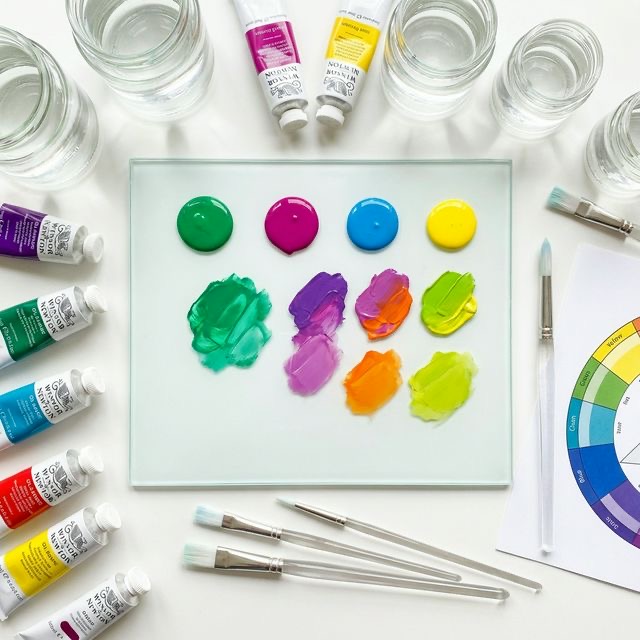
    It is time to conquer the color phobia. Let's explore the psychology behind this fear, and learn how to safely and comfortably reintroduce vibrant, joyful color into your creative life.
  • Posted on

    The phrase "monochromatic" often carries an unfair reputation in the design world. For many beginners, it brings to mind the image of a sterile, boring, and utterly flat room painted entirely in beige.

    But when used correctly, a monochromatic color scheme is actually the fastest and most reliable way to make an object look expensive, luxurious, and deeply dramatic. Think of a high-end fashion runway where a model is draped head-to-toe in different textures of black, or a modern living room layered with deep navy blue walls, a cobalt blue sofa, and pale icy blue linen curtains.

    Mastering a single color is not a limitation; it is an incredible creative challenge that forces you to rely on texture, pattern, and value to create visual interest. Because there is practically zero risk of color clashing, it is the perfect playground for beginner crafters. Let's break down how to create a breathtaking monochromatic masterpiece.

  • Posted on

    If you have spent your crafting career relying on safe, soft, monochromatic blues and calming analogous greens, the idea of throwing yellow, red, and blue together onto a single canvas might sound terrifying.

    For many beginners, mixing multiple highly saturated, diverse colors feels like a recipe for a clownish, chaotic disaster. But what if you want to make a quilt that absolutely explodes with energy? What if you want to paint a vibrant, pop-art style portrait that demands the viewer's attention from across the room?

    To achieve bold, brilliant energy without crossing the line into a visual mess, professional artists turn to a specific, highly structured mathematical formula: the Triadic Color Scheme.

    Let's break down exactly what this powerful color tool is, and learn how to wield it to create lively, dynamic, and perfectly balanced crafts.

  • Posted on

    When staring at a massive spectrum of yarns, paints, or fabrics in a craft store, it is incredibly easy to get overwhelmed. With infinite possibilities, how do you choose a color combination that is guaranteed to look beautiful, sophisticated, and soothing?

    One of the most trusted and universally adored formulas in the entire art world is the "Analogous Color Scheme."

    If you have ever stopped to admire the soft, seamless blend of an autumn sunset, the layered greens of a dense forest canopy, or the gentle gradient of a blooming rose, you have been admiring analogous colors in nature. Let’s explore exactly what an analogous color scheme is, and how you can use this simple color wheel trick to elevate your next crafting project.

  • Posted on

    Have you ever walked into a beautifully decorated room, or looked at a stunning handmade quilt, and wondered how the creator managed to combine four different colors without it looking like a chaotic mess?

    It is easy to assume that some people just have a natural "gift" for matching colors perfectly. But the truth is much more encouraging. In the world of design, there is a simple, foolproof mathematical formula that professionals use to balance colors. It is called the 60-30-10 Rule.

    Whether you are painting a living room, designing a scrapbook page, or picking out yarns for a new sweater, this one simple ratio will save you hours of frustration and guarantee a harmonious, perfectly balanced result every single time.

  • Posted on

    Staring at a massive wall of yarn at the craft store, or facing a blank white canvas, can be incredibly intimidating. With thousands of colors to choose from, how do you know which ones will look beautiful together, and which ones will clash?

    Many beginners assume that professional artists simply have a "good eye" for color—a magical, innate talent that cannot be taught. This could not be further from the truth. Professional artists rely on a very strict set of scientific rules known as Color Theory.

    Color theory is not magic; it is simply math and relationships. Once you understand the basic vocabulary and a few foolproof formulas, you will never struggle to pick a color palette again. Consider this your ultimate, beginner-friendly cheat sheet to mastering the color wheel.

  • Posted on

    We have all experienced this exact decorating disaster: You spend hours at the hardware store staring at tiny paint chips. You finally select the perfect, cozy shade of "Warm Vanilla" for your living room. You bring the expensive gallon of paint home, roll it onto the walls, and suddenly the room looks like a sickly, sterile, neon-yellow hospital waiting room.

    You didn't buy the wrong paint color. You have the wrong light bulbs.

    In interior design, color temperature is the invisible conductor that orchestrates the entire feeling of a room. You can buy the most expensive, beautifully colored furniture in the world, but if you illuminate it with the wrong color temperature, the design will fail.

    Let's demystify the science of color temperature and learn exactly how to choose the right lighting to make your home decor look like it belongs in a magazine.

  • Posted on

    Have you ever spent hours meticulously mixing the perfect shade of blue paint in your studio, only to bring the finished project into your living room and discover it looks terribly purple? Or perhaps you crocheted a blanket using what you thought was a warm, cozy cream yarn, but under the fluorescent lights of your office, it looks sickly and green.

    You are not losing your mind, and your eyes are not playing tricks on you. This is a very real, incredibly common scientific phenomenon known as metamerism. The truth is, color does not exist in a vacuum. Color is simply how our brains interpret light bouncing off an object. Therefore, if you change the light, you fundamentally change the color.

    Understanding how lighting affects color is one of the most critical, yet frequently overlooked, skills a crafter or artist can develop. Let's illuminate the science behind this frustrating problem and learn how to master color across any environment.

  • Posted on
    How to Mix Vibrant Colors Without Getting 'Mud'

    Every beginner painter has experienced this exact heartbreak: You squeeze out a beautiful puddle of bright blue paint, and right next to it, a beautiful puddle of bright yellow. You mix them together, expecting to see a brilliant, glowing emerald green. Instead, you get a flat, dull, murky olive sludge.

    In the art world, we call this sludge "mud." It is the most common frustration for beginner painters and crafters.

    So, what went wrong? Why didn't your blue and yellow make a bright green? The answer lies in a hidden scientific rule called "Color Bias." Once you understand how color bias works, you will completely eliminate mud from your palette, unlocking the ability to mix incredibly bright, vibrant, jewel-toned colors every single time.

  • Posted on
    Creating Skin Tones: A Color Mixing Guide

    Painting a realistic human portrait is often considered the ultimate test of an artist's ability. Beyond capturing the correct proportions of the face, the hardest part of portraiture is undeniably mixing the perfect skin tone.

    Many beginners try to take shortcuts by mixing white paint with orange, or worse, buying a tube of pre-mixed "flesh tint." These shortcuts almost always result in portraits that look chalky, plastic, or completely lifeless.

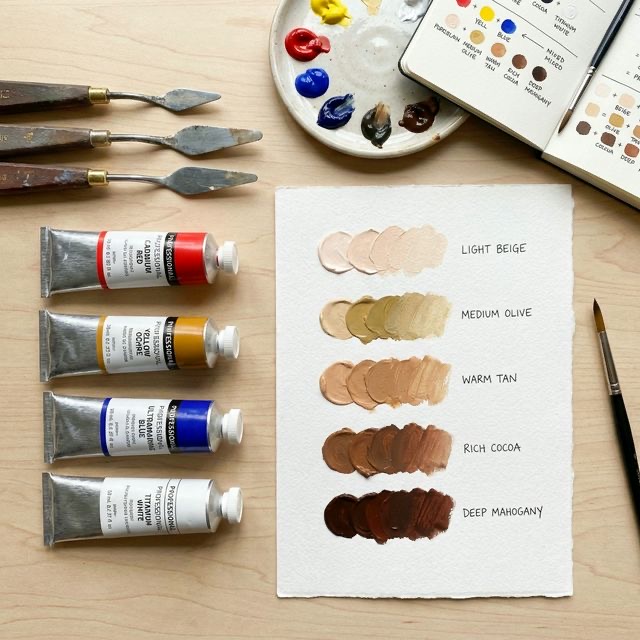
    The truth is, human skin is incredibly complex. It is translucent, entirely unique to the individual, and constantly reflecting the colors around it. However, the foundational rules for mixing realistic skin tones are surprisingly simple. Regardless of whether you are painting deep mahogany or pale ivory, the formula is exactly the same. Let’s dive into the ultimate color mixing guide for creating realistic, beautiful skin tones.