
- Posted on
- • Paint Mixing
How to Mix Vibrant Colors Without Getting 'Mud'
- Author
-
-

- User
- C&C Admin
- Posts by this author
- Posts by this author
-
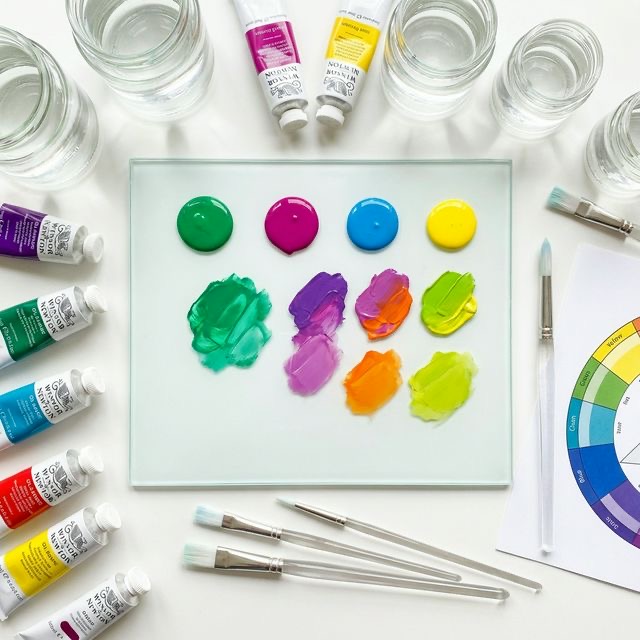
Every beginner painter has experienced this exact heartbreak: You squeeze out a beautiful puddle of bright blue paint, and right next to it, a beautiful puddle of bright yellow. You mix them together, expecting to see a brilliant, glowing emerald green. Instead, you get a flat, dull, murky olive sludge.
In the art world, we call this sludge "mud." It is the most common frustration for beginner painters and crafters.
So, what went wrong? Why didn't your blue and yellow make a bright green? The answer lies in a hidden scientific rule called "Color Bias." Once you understand how color bias works, you will completely eliminate mud from your palette, unlocking the ability to mix incredibly bright, vibrant, jewel-toned colors every single time.
1. The Myth of the "Pure" Primary Color
When we learn about the color wheel in elementary school, we are taught a very simplified version of reality. We are taught that Red, Yellow, and Blue are the "primary" colors, and they cannot be created by mixing other colors together.
While this is technically true, it ignores the reality of how paint is manufactured.
Unless you are working in a highly controlled digital environment or a physics lab, you will never find a "pure" primary color at the craft store. Every single tube of paint you buy contains microscopic impurities. Because of these impurities, every primary color "leans" toward one of its neighbors on the color wheel. This is called Color Bias.
- A tube of yellow paint might lean slightly toward green (Cool Yellow) or slightly toward orange (Warm Yellow).
- A tube of red paint might lean slightly toward orange (Warm Red) or slightly toward purple (Cool Red).
- A tube of blue paint might lean slightly toward purple (Warm Blue) or slightly toward green (Cool Blue).
2. The Formula for Mud (And How to Avoid It)
Now that we know about color bias, we can explain exactly why your paints keep turning to mud.
To review basic color theory: mingling all three primary colors together (Red + Yellow + Blue) creates brown, grey, or black (mud).
Therefore, the absolute golden rule of mixing vibrant colors is this: You must never invite the third primary color to the party.
Why Your Green Turned to Mud:
Let's go back to our earlier example. You mixed blue and yellow together, but you got a muddy olive green instead of a bright emerald green. * The mistake: You probably used a Warm Yellow (which contains hidden red) and a Warm Blue (which also contains hidden red). * The result: You thought you were only mixing Yellow and Blue. But because of color bias, you were actually mixing Yellow + Blue + a tiny bit of Red. Because all three primaries were present, the color neutralized and turned to mud.
How to Mix a Vibrant Green:
To get a bright, blazing neon green, you must ensure absolutely NO red is present in the mixture. * The solution: You must use a Cool Yellow (like Lemon Yellow, which leans toward green) and a Cool Blue (like Cerulean or Phthalo Blue, which also leans toward green). Because both colors lean toward each other and away from red, the resulting mixture will be unimaginably bright and clean.
3. The "Split Primary" Palette
If you want to guarantee that you can always mix clean, vibrant colors, you need to abandon the idea of a 3-color palette (one red, one yellow, one blue).
Instead, professionals use a "Split Primary Palette." This means you need six core paints: a warm and a cool version of each primary color.
The Ultimate Vibrant Crafting Palette: 1. Warm Yellow (e.g., Cadmium Yellow Deep): Leans toward orange. 2. Cool Yellow (e.g., Lemon Yellow): Leans toward green. 3. Warm Red (e.g., Cadmium Red Light): Leans toward orange. 4. Cool Red (e.g., Alizarin Crimson or Quinacridone Magenta): Leans toward purple. 5. Warm Blue (e.g., Ultramarine Blue): Leans toward purple. 6. Cool Blue (e.g., Phthalo Blue or Cerulean): Leans toward green.
Armed with these six tubes, you have absolute control over the vibrancy of your mixes.
4. The Cheat Sheet for Vibrant Secondary Colors
If you have your Split Primary palette ready, here is exactly which tubes to combine to achieve maximum, jaw-dropping vibrancy.
How to Mix Vibrant Orange
To mix a clean orange, you must ensure absolutely no blue is present. * The Mix: Combine Warm Yellow (leans towards orange) and Warm Red (leans towards orange). * The Mud Warning: If you accidentally use a Cool Red (which contains hidden blue), your orange will instantly turn brown.
How to Mix Vibrant Purple
Purple is notoriously the hardest color to mix cleanly. To get a brilliant violet, you must ensure absolutely no yellow is present. * The Mix: Combine Cool Red (leans towards purple) and Warm Blue (leans towards purple). * The Mud Warning: If you accidentally use a Warm Red (which contains hidden yellow), your purple will turn into a hideous, muddy maroon.
How to Mix Vibrant Green
To mix a clean green, you must ensure absolutely no red is present. * The Mix: Combine Cool Yellow (leans towards green) and Cool Blue (leans towards green). * The Mud Warning: If you use Ultramarine Blue (which contains red), your green will turn into a swampy olive.
Conclusion
Creating mud on your palette is not a sign of failure; it is simply a reflection of the chemistry of your paint tubes! Once you stop viewing Red, Yellow, and Blue as "pure" ingredients, the entire color wheel opens up to you.
By utilizing the Split Primary system and being highly aware of color bias, you can ensure that the third primary color never accidentally sneaks into your mixtures. The next time you sit down to craft, check your paint labels, pick the tubes that lean toward each other, and prepare to mix the brightest, cleanest colors you have ever seen.