
- Posted on
- • Crafting Basics
Complementary Colors: Why Opposites Attract in Art
- Author
-
-

- User
- C&C Admin
- Posts by this author
- Posts by this author
-
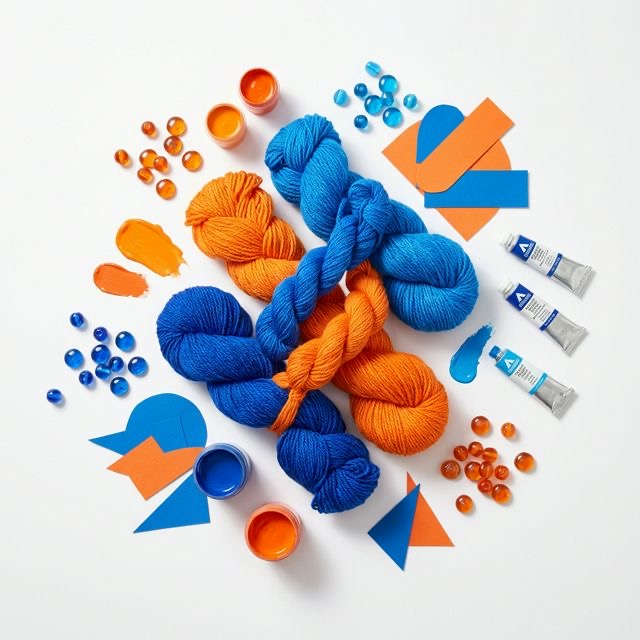
Have you ever wondered why superhero costumes look so striking? Why is Spider-Man predominantly red and blue? Why does the Incredible Hulk sport green skin and purple pants? It is not a coincidence. Comic book artists, painters, interior decorators, and master crafters all share the same powerful secret weapon: Complementary Colors.
In the world of color theory, the phrase "opposites attract" is not just a romantic cliché; it is a scientific fact. When you pair two colors that sit directly across from each other on the color wheel, you create a visual explosion.
Understanding how to use complementary colors can instantly take your artwork from feeling flat and boring to vibrant and professional. However, this power comes with a catch: if you use complementary colors incorrectly, they can literally give your audience a headache! Let’s dive deep into the science behind complementary colors and learn how to use them perfectly in your next craft project.
1. What Are Complementary Colors?
To understand complementary colors, you simply need to look at a traditional 12-part color wheel. Find any color on the wheel, trace a straight line through the center to the exact opposite side, and you have found its complement.
There are three main, classic pairs of complementary colors based on the traditional primary and secondary colors:
Red and Green
This is perhaps the most famous pairing. Red (a primary color) sits directly across from green (the secondary color made by combining the other two primaries: blue and yellow). Because they are exact opposites, red and green provide incredible contrast. This pairing is most commonly associated with Christmas, but it is also abundantly found in nature (think of a bright red apple hanging among lush green leaves, or a field of red poppies).
Blue and Orange
Blue (a primary color) sits directly across from orange (made from red and yellow). This is one of the most popular pairings in modern graphic design and cinema. Blue is the coolest color on the wheel, and orange is the warmest. When placed together, they create a thrilling, electric contrast that is almost impossible to look away from. (This is why almost every major movie poster uses a blue and orange color grade!).
Yellow and Purple
Yellow (a primary color) sits directly across from purple (made from blue and red). This pairing creates the highest contrast in value (light vs. dark). Yellow is the lightest color on the wheel, while pure purple is the darkest. This makes them an incredibly rich, regal, and bold combination.
But the rule doesn’t stop at the primary colors. You can pair tertiary colors, too! * Blue-Green (Teal) is complementary to Red-Orange (Rust). * Yellow-Green (Chartreuse) is complementary to Red-Purple (Magenta).
2. The Science of the "Vibration" Effect
Why do these opposite pairings look so incredibly bright when placed next to each other? The answer lies in how the human eye and brain process light.
Inside your eye, there are specialized cells called cones that detect color. You have specific cones for detecting red, green, and blue light. When you stare at a large block of bright red paint for a long time, the red-detecting cones in your eye get exhausted and become fatigued. Because they are tired, your eye naturally starts relying more on the green and blue cones to compensate.
If you suddenly shift your gaze from that red block to a green block, your green cones are completely fresh and hyper-sensitive. The green will look significantly brighter and more intense than it actually is!
Simultaneous Contrast
When you put a complementary pair right next to each other, like a blue stripe directly touching an orange stripe, your eye's cones are rapidly firing back and forth. This creates an optical illusion known as simultaneous contrast. The boundary where the two colors meet literally appears to vibrate or hum with energy.
- The blue makes the orange look Oranger.
- The orange makes the blue look Bluer.
They completely maximize each other's intensity. This is the superpower of complementary colors.
3. The Danger of the 50/50 Split
Because complementary colors maximize intensity and can create a vibrating optical illusion, they must be handled with care. The biggest mistake beginners make when using complementary colors in a craft project is using them in a 50/50 split.
If you knit a sweater using exactly half pure orange yarn and half pure blue yarn, the contrast will be so intense that the viewer's eye will not know where to focus. The bright colors will constantly fight for dominance, and looking at the sweater for too long will become visually fatiguing (or even cause a mild headache).
The Solution: The 80/20 Rule
To fix this, professional designers use the 80/20 rule. You must pick one color to be the dominating background (the 80%), and use its complement strictly as a tiny, powerful pop of accent color (the 20%).
- In Home Decor: Instead of painting half a room purple and half yellow, paint the walls a soft, muted, dusty purple. Then, place a single, bright mustard-yellow throw pillow on the couch. The yellow will pop beautifully without overwhelming the space.
- In Scrapbooking: If your background paper is a dominant, deep navy blue, use a tiny splash of bright orange border tape around your central photograph. The orange will immediately draw the eye specifically to the photo.
4. Nuance: Mixing Tints, Tones, and Shades
It is important to remember that complementary colors do not always have to be pure, blinding, neon hues. You can use the complementary relationship to create incredibly sophisticated, subtle, and earthy projects by utilizing tints (adding white), tones (adding grey), and shades (adding black).
Softening the Contrast
If the pure red and green combination feels too "Christmas-y" for your project, try shifting their values. Pair a deep, dark shade of burgundy (dark red) with a soft, pale mint green (light green). The underlying complementary relationship remains, offering perfect harmony, but the harsh vibration is completely gone.
The Secret to Perfect Neutrals
Here is another massive secret of complementary colors: they cancel each other out! If you mix equal parts of a red paint and a green paint together, you will not get an ugly, unnamable sludge. You will create a perfectly balanced, rich, neutral grey or brown.
Professional painters almost never use black paint straight from the tube to create shadows. It looks flat and unnatural. Instead, if they are painting a blue object, they will mix a tiny drop of orange into the blue to darken and mute it naturally. By mixing complementary colors together, you create the most beautiful, earthy, and realistic shadows possible.
5. Practical Uses in Everyday Crafts
Here are a few quick ways you can immediately start applying complementary colors to your hobbies:
- Watercolor and Acrylic Painting: If you want an object to pop off the canvas, paint the background in a cool, dark complement. Want a bright yellow lemon to look incredibly vibrant? Paint the tablecloth beneath it a deep, cool purple. The contrast will make the lemon glow.
- Embroidery and Cross Stitch: When stitching on a dark, blue-green (teal) fabric, do not use white thread for your main design. Use a bright, contrasting coral or rust-orange thread. The design will jump off the fabric beautifully.
- Floral Arrangements and Wreaths: Nature already understands this rule perfectly. This is why purple irises feature bright yellow centers! Try pairing deep purple lavender sprigs with bright yellow sunflowers for an instantly stunning summer wreath.
Conclusion
Complementary colors are the ultimate tool for controlling visual energy. They are the loudest, boldest, most attention-grabbing combination a crafter can use.
By understanding the science of the color wheel, the optical illusion of simultaneous contrast, and the vital importance of the 80/20 rule, you can harness this energy without letting it overpower your work.
The phrase "opposites attract" is the foundation of great art. The next time you want your project to truly pop, find your primary hue, draw a line straight across the color wheel, and let the magic of contrast do all the heavy lifting!