
- Posted on
- • Paint Mixing
How to Mix the Perfect Brown Every Time
- Author
-
-

- User
- C&C Admin
- Posts by this author
- Posts by this author
-
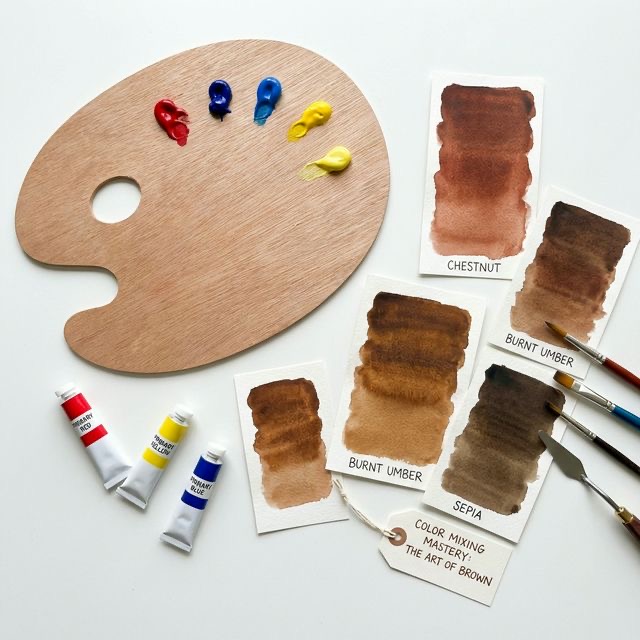
If you walk into any craft or art supply store, you will see dozens of tubes with names like "Burnt Umber," "Raw Sienna," and "Van Dyke Brown." While it is incredibly convenient to buy these pre-mixed paints, relying on them completely is one of the biggest mistakes a beginner artist can make.
When you buy a tube of brown paint, you are stuck with that exact shade. But if you learn how to mix your own browns from scratch, you unlock the ability to create thousands of highly nuanced, perfectly matched earth tones.
Mixing brown is often a source of frustration for beginners, usually resulting in a muddy, lifeless grey sludge. But there is a very simple, scientific formula behind it. Today, we are going to demystify the color wheel and learn the foolproof method for mixing the perfect brown every single time.
1. The Golden Rule: The Three Primaries
The absolute most important rule of color mixing is this: To make brown, you must mix all three primary colors together.
That is the entire secret. If you have pure Red, pure Yellow, and pure Blue on your palette, you have everything you need to create any brown in the universe.
The reason this works goes back to basic color theory. Brown is what we call a "tertiary" or "neutralized" color. When you mix the three primaries together in roughly equal amounts, they actually cancel each other out. Their individual brilliances are neutralized, resulting in a dark, earthy tone.
The Problem With "Equal Parts"
If you squeeze out exactly 33% Red, 33% Yellow, and 33% Blue and mix them together, you probably won't get a beautiful brown. You will likely get a very dark, almost black sludge.
Why? Because chemically, blue pigment is much stronger and darker than yellow and red pigment. A tiny drop of blue will completely overpower a large puddle of yellow.
To mix a beautiful brown, you do not use equal parts. You use the Dominant/Subordinate Method.
2. The Foolproof Method: Opposites Attract
The easiest and most reliable way to ensure you mix a perfect brown is to use complementary colors. Complementary colors are colors that sit directly across from each other on the color wheel.
By definition, every complementary pair contains all three primary colors! * Pair 1: Orange and Blue. (Orange is made of Red + Yellow. Add Blue, and you have all three primaries). * Pair 2: Green and Red. (Green is made of Yellow + Blue. Add Red, and you have all three primaries). * Pair 3: Purple and Yellow. (Purple is made of Red + Blue. Add Yellow, and you have all three primaries).
Step-by-Step: The Orange and Blue Formula
This is the absolute best formula for beginners because it creates a beautiful, classic, warm brown.
- Mix a bright, pure Orange. Use roughly 60% Yellow and 40% Red. Do not stop until the orange looks like the skin of a tangerine.
- Add a tiny drop of Blue. Blue is your neutralizing agent. Take just a tiny touch of pure blue and mix it into the orange.
- Watch the magic happen. As you mix the blue in, the bright orange will instantly neutralize, turning into a rich, beautiful brown.
Because you started with a warm base (orange) and only added a tiny bit of blue, you will end up with a warm, reddish-brown, very similar to a Burnt Sienna.
3. Controlling the Temperature
Once you know the basic formula, you can control the exact temperature of your brown. Not all crafts need a warm, reddish-brown. Sometimes you need a cool, shadowy brown to paint the bark of a tree at midnight.
Controlling the temperature is all about adjusting the ratios of your three primary colors.
Mixing Warm Browns (Brick, Rust, Chestnut)
Warm browns have a higher ratio of Red and Yellow. * The Formula: Use the Orange + Blue method, but be very conservative with the blue. If the brown looks too dull, add a tiny drop of pure Red to warm it back up. * Best used for: Painting wooden furniture, rustic autumn landscapes, or cozy, sunlit subjects.
Mixing Cool Browns (Espresso, Ash, Dark Walnut)
Cool browns have a higher ratio of Blue. * The Formula: Use the Green + Red method. Mix a dark green (using more blue than yellow), and then neutralize it by adding a drop of red. * Best used for: Painting deep shadows, cool winter scenes, or modern, sleek wooden textures.
Mixing Golden Browns (Ochre, Sand, Camel)
Golden browns have a massive ratio of Yellow. * The Formula: Use the Purple + Yellow method. Instead of starting with purple, start with a massive puddle of Yellow. Mix a tiny bit of purple on the side, and slowly drag it into the yellow puddle. * Best used for: Painting sandy beaches, blonde hair, or sun-drenched desert landscapes.
4. How to Fix "Mud"
The most terrifying word in a painter's vocabulary is "mud." This happens when your brown stops looking like rich earth and starts looking like a flat, milky, lifeless grey.
Mud almost always happens for one of two reasons:
1. You Used Black Paint
Many beginners try to make their brown darker by adding bone black or ivory black paint. Never do this. Black paint is incredibly flat and will instantly kill the vibrancy of your brown, turning it into mud. * The Fix: If you need a darker brown, do not add black. Add more pure Blue, or add a dark, cool purple (like Dioxazine Purple). This darkens the brown while keeping it rich and colorful.
2. You Used the Wrong White
If you want to make a light tan or beige, you have to add white to your brown. However, adding stark Titanium White will quickly make your brown look chalky and dull. * The Fix: If you need to lighten a warm brown, add a touch of Yellow first, and then add a tiny bit of white. If you are painting with acrylics or oils, try keeping a tube of "Unbleached Titanium" or "Zinc White" on hand. These are slightly transparent, warm whites that lighten browns without turning them chalky.
Conclusion
Mixing your own brown is a rite of passage for every artist and crafter. It proves that you are no longer relying on what the art store tells you to use; you are in complete control of your own palette.
By remembering the golden rule—that all browns are just Red, Yellow, and Blue in disguise—you can confidently tackle any project. The next time you are painting a landscape, skip the pre-mixed Burnt Umber. Grab your primaries, mix an orange, add a drop of blue, and watch the exact color you need appear right before your eyes.